
Sushidot

The sushi guide

All 12 kinds of sushi in Roll Up! Sushi Merge

Every plate in Roll Up! is a real kind of sushi. Some are centuries-old Tokyo classics and some were invented in North America within living memory. Here they are in the order you make them in the game, with what each one is and where it comes from.

At a conveyor-belt sushi restaurant, or kaiten-zushi, the color of the plate tells you the price. Roll Up! borrows the idea: white plates are the everyday ones and gold plates are the rarest. The number next to each sushi is its value in the game. Two of the same sushi merge into the next one, so each is worth twice the one before.

Cucumber Roll drawn on a white plate

1. Cucumber Roll

かっぱ巻き · kappa maki · White plate · 2 points

Named after the kappa, a water spirit from Japanese folklore that loves cucumbers. A thin roll, or hosomaki, with seaweed on the outside and a single strip of cucumber in the middle. Its clean, crisp taste makes it a common way to refresh the palate between richer pieces. In Roll Up! it is the plate every game starts with.
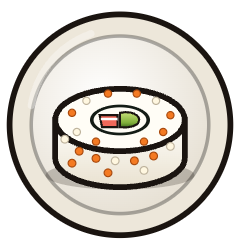

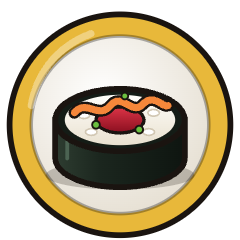
California Roll drawn on a white plate

2. California Roll

カリフォルニアロール · kariforunia rōru · White plate · 4 points

Born in North America. The rice goes on the outside so the seaweed stays hidden. An inside-out roll, or uramaki, usually filled with crab or imitation crab, avocado and cucumber, and often rolled in sesame seeds or fish roe. It appeared in the 1960s and 70s; chefs in both Los Angeles and Vancouver are credited with it. It introduced many people outside Japan to sushi.

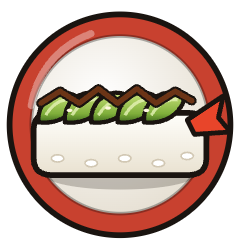
Tamago drawn on a blue plate

3. Tamago

玉子 · tamago · Blue plate · 8 points

A sweet rolled omelet. Some diners judge a sushi chef by their tamago. Tamagoyaki is made by cooking thin layers of seasoned egg in a rectangular pan and rolling them up one after another. As sushi, a slice is laid on rice and often tied on with a thin band of seaweed. In Roll Up!, making your first Tamago is what brings the first guest to the counter.

Shrimp Nigiri drawn on a blue plate

4. Shrimp Nigiri

えび · ebi · Blue plate · 16 points

The shrimp is boiled on a skewer so it stays straight, then butterflied. Cooked shrimp on rice, with the tail left on. Because it is cooked, it is a popular first piece for people who are new to sushi. Its raw cousin, sweet shrimp or amaebi, is a different item on the menu.

Spicy Tuna Roll drawn on a yellow plate

5. Spicy Tuna Roll

スパイシーツナ · supaishī tsuna · Yellow plate · 32 points

An American sushi-bar classic. The spicy mayo is a US twist. Chopped tuna mixed with a chili sauce or spicy mayonnaise, rolled with rice and seaweed. It became popular in American sushi bars in the 1980s and is a clever use of the tuna trimmings left over from cutting neater slices.

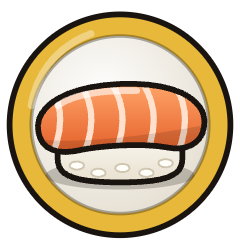
Salmon Nigiri drawn on a yellow plate

6. Salmon Nigiri

サーモン · sāmon · Yellow plate · 64 points

Raw salmon sushi only caught on in Japan in the 1980s and 90s, helped by Norwegian exporters. For most of history salmon was eaten cooked or cured in Japan, because wild Pacific salmon can carry parasites. Farmed Atlantic salmon, promoted by Norway from the 1980s, changed that. Today it is one of the most popular toppings at conveyor-belt restaurants.

Dragon Roll drawn on a red plate

7. Dragon Roll

ドラゴンロール · doragon rōru · Red plate · 128 points

Avocado slices laid on top like dragon scales. Built to impress at US sushi bars. An inside-out roll, usually filled with shrimp tempura or eel and cucumber, covered with thin slices of avocado and finished with a sweet soy glaze. There is no single recipe: every sushi bar builds its dragon a little differently.

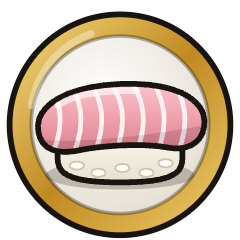
Tuna Nigiri drawn on a red plate

8. Tuna Nigiri

まぐろ · maguro · Red plate · 256 points

Akami, the lean red cut, is the traditional star of old Tokyo-style sushi. Tuna is divided into three main cuts: akami, the lean red meat, chūtoro, the medium-fatty belly, and ōtoro, the fattiest part. In old Tokyo, before refrigeration, akami was often marinated in soy sauce so it would keep. That style is called zuke.

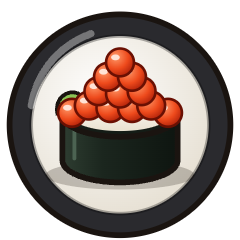
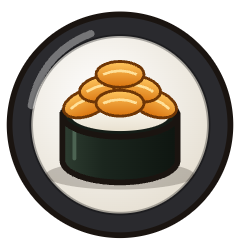
Salmon Roe drawn on a black plate

9. Salmon Roe

いくら · ikura · Black plate · 512 points

The word ikura comes from the Russian ikra, meaning fish roe. Salmon eggs cured in salt or soy sauce, served as gunkan-maki, a "battleship roll": a ball of rice wrapped in a tall strip of seaweed so the loose topping stays on. The battleship style is credited to a Tokyo sushi restaurant in 1941.

Sea Urchin drawn on a black plate

10. Sea Urchin

うに · uni · Black plate · 1,024 points

Creamy and sweet. Santa Barbara, California is famous for its uni. The part that is eaten is the roe-producing organ of the sea urchin; each one holds five pieces. It ranges from pale yellow to deep orange and is usually served battleship style. In Japan, Hokkaido is especially known for it.

Otoro drawn on a gold plate

11. Otoro

大トロ · ōtoro · Gold plate · 2,048 points

The fattiest part of the bluefin tuna belly. It was once thought too greasy to eat. Before refrigeration, fatty tuna spoiled quickly and was considered a low-grade cut. As cold storage spread in the twentieth century it became the most prized piece on the menu. In Roll Up!, making Otoro is the 2,048 moment and counts as a win.

Golden Omakase drawn on a gold plate

12. Golden Omakase

おまかせ · omakase · Gold plate · 4,096 points

Omakase means "I leave it to you." The chef chooses every piece. At a sushi counter, ordering omakase means the chef serves a sequence of pieces, usually one at a time, built around the best fish of the day. In Roll Up! it is the final plate, made by merging two Otoro.

Words you will see at a sushi counter

Want to collect all twelve? Play Roll Up! or read how to play first.